Art, mental health and wellbeing
We place mental health and wellbeing at the heart of our curatorial practice, exploring how art and visual storytelling can transform the spaces around us into places of imagination, dignity and hope by opening dialogue, challenging stigma and creating space for healing.
Our work
Wellbeing at work runs through all our exhibitions and cultural programmes. By bringing art and live music into the places people use each day, we create opportunities for reflection, conversation and connection within working life.
Our two exhibitions at Clinique La Métairie in Nyon extend this commitment into a specialist mental health setting. They hold particular significance for us: each grew from a rare collaboration between curatorial practice, psychiatrists, psychologists, and the clinic’s management and communications team. We are especially proud of these projects, shaped through sustained dialogue between those who make and present art and those who provide care.
Founded in 1860, La Métairie describes itself as the first, and today the last, private psychiatric clinic in French-speaking Switzerland. Set in its own park in Nyon, on Lake Geneva, it has cared for people living with mental illness for more than a century and a half, with a therapeutic approach that already makes room for the arts.
It is a rare setting for an exhibition: a place of care whose corridors become, for a time, a gallery, timed to coincide with the Canton of Vaud’s Mental Health Month and open to the public by appointment only.
Our thinking owes much to Franco Basaglia, the Italian psychiatrist whose reform of 1978 closed Italy’s asylums, and to the conviction, written on the walls of the hospital in Trieste, that freedom is therapeutic. There, in 1973, patients and artists built Marco Cavallo, a blue horse four metres tall. It was too large to leave through the doors, so the wall was broken and the horse walked out into the city.
We work in the same spirit. The question is not what art can do for patients, but how creative work can turn experience into feeling — something that can be seen, shared and recognised — so that the line between those who are cared for, those who care and those who visit begins to soften, and no one is defined by a diagnosis.
SOLITUDE(S) — September–October 2025
The project was initiated by GianPaolo Benedetti, then Head of Psychologists at Clinique La Métairie, who invited ArtMoorHouse to curate it.
Developed with Clinique La Métairie and FOCALE, SOLITUDE(S) brought photographs into dialogue with the words, emotions and reflections of patients taking part in photo-mediation groups. Our curatorial approach placed this shared authorship at the heart of the exhibition. Through audio readings accompanying the photographs, we invited visitors to encounter the patients’ responses alongside their own, opening up different ways of seeing and feeling. The intention was to question the distance we might imagine between ourselves and others, revealing how a shared image can speak to each of us differently.
The Weight of What Can’t Be Seen (Le Poids de l’invisible) — Elyzar Flores, 11 September – 25 October 2026
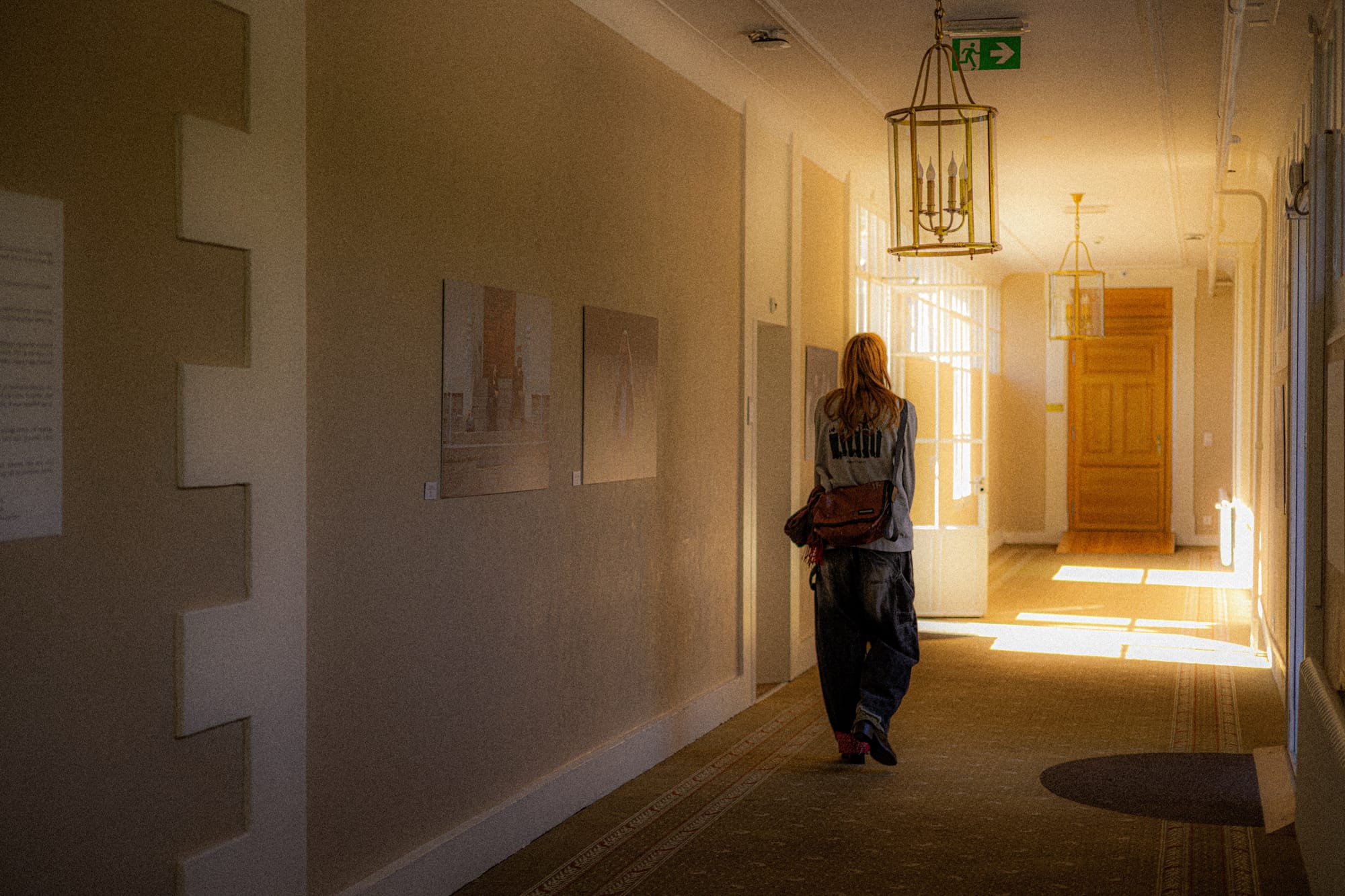
Elyzar Flores made these photographs during a month-long stay for care at the clinic: visual notes, each holding a moment of his inner experience. Working directly with the artist and with the clinic’s management, our role as curators was to give that experience a form others could enter. Thirteen photographs line the corridor gallery of the clinic’s nineteenth-century building, each linked by an NFC tag to the poem, soundscape or piece of music that accompanied his emotions, so that visitors meet the image and the thought together, as he lived them. The exhibition is presented as part of the Canton of Vaud’s Mental Health Month. Read more
At Moor House, music plays a different part. In Live at ArtMoorHouse, pianist and composer Antimo Magnotta performs at lunchtime in the reception of the building. Each concert is a pause in the working day, where listening becomes a shared and restorative moment. Live music
Why it matters
Over the past decade, research into the arts and health has moved from anecdote to evidence. In 2019 the World Health Organization published the largest review of its kind, drawing on more than 3,000 studies. It found that the arts play a significant part in preventing ill health, in supporting recovery and in helping people live with long-term conditions.
Professor Daisy Fancourt, who leads the WHO Collaborating Centre for Arts and Health at University College London, describes the arts as “the forgotten fifth pillar of health”, alongside sleep, diet, exercise and nature. Her book Art Cure (2026) brings together much of this research for a general reader.
As Fancourt puts it, art is not a panacea, but neither is it a placebo: research has begun to identify the biological and social mechanisms through which it works.
What the research shows
- Prevention and recovery. The WHO review of over 3,000 studies found a major role for the arts in the prevention of ill health and in the management and treatment of illness across the life course. WHO report, 2019
- Cultural life and longevity. A UCL study following 6,710 adults over 50 for fourteen years found that visiting museums, galleries, exhibitions, concerts or the theatre every few months was associated with a 31% lower risk of death during the follow-up period, compared with those who never did. UCL, 2019
- Stress. In a small study of 39 adults, cortisol levels fell in 75% of participants after 45 minutes of art-making, whatever their artistic experience. Drexel University, 2016
Our approach
We do not present art as treatment. We present it as company: something to stand beside, to return to and to share. In a clinic, an office or a shared hall, an exhibition can offer a reason to pause, a subject for conversation and a quiet acknowledgement that the spaces in which we work and recover deserve care.
Every project is developed with the people responsible for the building — clinicians, managers and staff — so that the work respects the rhythms and sensitivities of the place.
Further reading
- World Health Organization, What is the evidence on the role of the arts in improving health and well-being? A scoping review (2019)
- Daisy Fancourt, Art Cure (2026)